
Writing about creating a game feels apt with the FIFA Men’s World Cup underway. Sports and games have always inspired me, both as entertainment and as tools for learning. Although I’m competitive, I’ve always recognised that sports and games teach vital skills like teamwork, communication and leadership. However, they are also a vessel for communicating research. I was inspired by Assistant Professor Dr Elizabeth Driscoll when we were both PhD students after a presentation on how she created ‘Battery Jenga’ to explain her lithium battery work, proving that academic ideas can be both playful and accessible.
In April, I was invited to lead a Future Geographers session at the Geographical Association Annual Conference, explaining my research, which explored how Caribbean restaurants and takeaways advertise to superdiverse communities. I knew teenagers would be my audience and through my outreach experience, I knew whatever I did had to be interesting (or not boring). Understanding your audience is always crucial; if your message fails to connect, you risk losing them entirely. Therefore, I decided to present my research as a board game.
Together with Fiona Sheriff, president of the Geographical Association, we applied for a grant of approximately £400 from the University of Birmingham Public Engagement Rapid Fund, which offers up to £500 for public engagement projects. The beauty of the Rapid Fund lies in its efficiency; a decision is made within two weeks.
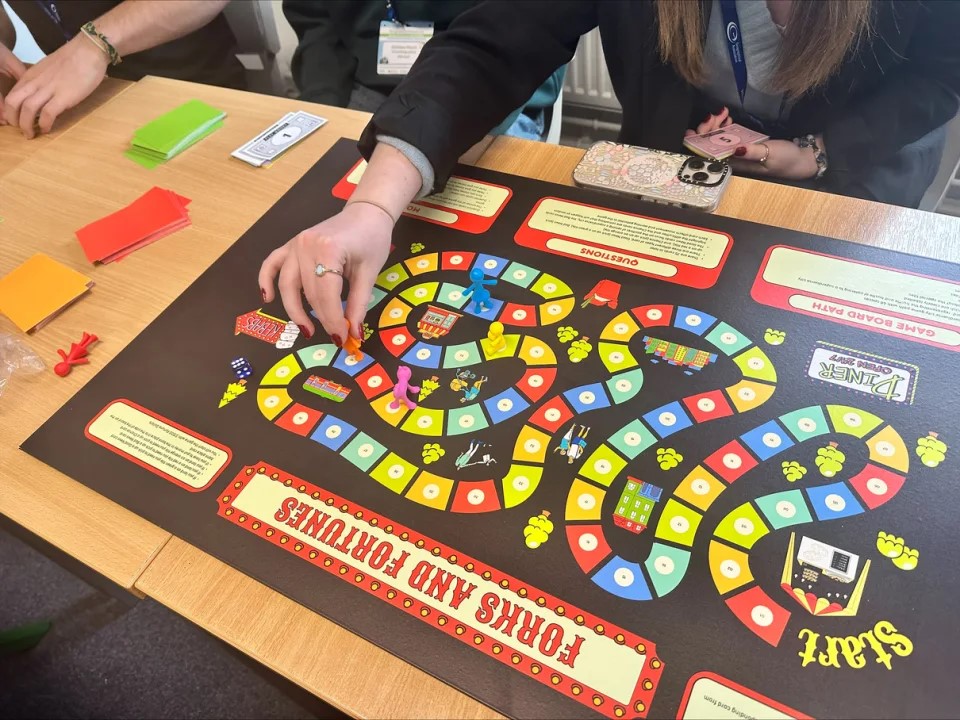
The game had a Monopoly-esque feel, where players owned a restaurant in a superdiverse city. As they navigated the board, they’d encounter various cards reflecting the real-world complexities and benefits of marketing in such an environment. Three sets of cards guided gameplay: green cards highlighted positives and allowed players to advance or collect money; red cards presented challenges, forcing players to retreat or pay penalties; and orange cards acted as ‘chance’ cards, introducing unpredictable outcomes. In total, there were 75 cards, each designed to mirror the intricacies of advertising to a superdiverse landscape.
Canva played a vital role in creating the board game; I used one of their boardgame templates, replacing the template images with food-related ones to match the games’ theme. The University’s Creative Media team were invaluable, collaborating with me over six weeks to ensure a high-quality result within budget. I learned about MDF boards, sanding, and vinyl application. I enjoyed working with a new team and we were all pleased with the result.
Student feedback at the Future Geographers event was positive, with one calling the game “surprisingly good”! Additionally, a pre-session and post-session survey showed their understanding of superdiversity increased after playing.
Recently, I spoke about my board game at a creativity symposium, reiterating my belief that creativity provides accessibility, and accessibility is a necessity. The board game succeeded in translating a complex concept into something that students could understand and engage with.
I describe myself as a ‘pracademic’, a practical academic, a term I learnt from the Open University. I feel not everything can be communicated by a paper, and not everyone has access to papers, therefore it is important to be able to convey your research in alternative formats.
Discover more from UoB PGR Development blog
Subscribe to get the latest posts sent to your email.