
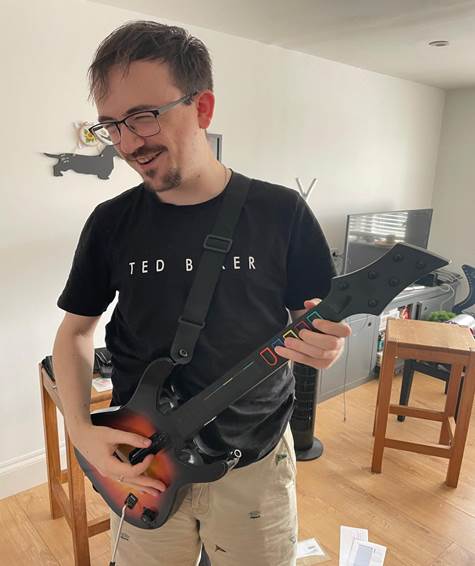
Expensing a Guitar Hero controller was not on my postgraduate researcher bingo card for 2025.
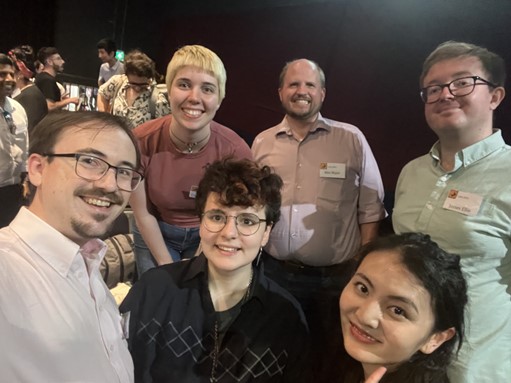
Yet, last July I found myself on the train to the University of East London’s Stratford campus with a plastic guitar in my bag and some meticulously curated slides on my laptop.
I was travelling to present at the 2025 Fourteenth Annual European Ludomusicology conference. Ludomusicology is a field of music concerned with the nature of music and games, often (although not exclusively) video games. Utilising UoB’s Postgraduate Work Experience Bursary (PGWEB), which can extend to covering some conference costs, I was going to present on one of the most iconic rhythm games of the last two decades: Guitar Hero.
Guitar Hero was originally released in 2005 and took the living rooms of the world by storm as players were challenged to play along on the iconic plastic guitar controller to some of the biggest rock hits of the last century.
However, due to a changing video game market and franchise mismanagement, by 2015 the series had gone dormant. A dedicated fanbase remained, and since 2011 a fan-made spinoff called Clone Hero was being developed. During the Covid-19 lockdown, Twitch streamers like “acai” and “jasonParadise” promoted a resurgence in interest in Guitar Hero, propelling Clone Hero to more mainstream popularity.
There was always at least one truly fiendish song (known as “charts” to the community) in each Guitar Hero game. In Guitar Hero III: Warriors of Rock (the game my family were obsessed with as I was growing up), that chart was “Through the Fire and Flames” by Dragonforce, and is credited by many as having introduced a new generation to their music. However, as players grew more skilled, even this chart’s fiendish difficulty was eclipsed by players playing it with 100% accuracy on increased speeds, or while blindfolded. Thus, the community set out to write ever-more fiendish charts, and in the process ended up composing original music for the game. My paper, which I presented alongside other works from some great friends and academics from Royal Holloway (RHUL), examined the work of charter/composer “ExileLord”, and examined how, in his quest to push the boundaries of players’ technical prowess, he mirrors both the compositional processes and pedagogic intent of composers like Bach and Paganini.
I would strongly encourage any PGR who is interested in presenting at a conference in their field to consider applying for the PGWEB. It can help support travel and accommodation costs, as well as sourcing specialist equipment — including, it would seem, long out of production 20-year-old novelty video game controllers!
I will confess to a certain boyish glee at holding one of these controllers again! I have since learned how to play guitar, but I’m afraid to report that neither this nor a PhD in Music necessarily translates to improved gameplay skill.
Discover more from UoB PGR Development blog
Subscribe to get the latest posts sent to your email.