
Getting your PhD in for your deadline is no small feat, but what about the dreaded phrase ‘PhD viva’, and what does the result ‘major corrections’ actually mean?
When it came to my PhD Viva, after submitting and taking a good break (which I found to be very hard to do!) I started, truthfully, by over-preparing! I started drafting out potential answers and flashcards for my PhD Viva. I quickly realised this was problematic after attending the Preparing for your Viva session at the library and talking to my supervisors.
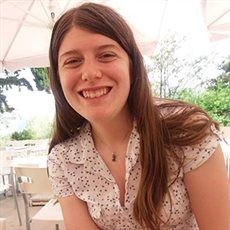
Instead, I just read my thesis and critiqued it, and this is what prepared me most for my Viva, alongside some mock Vivas with my PhD supervisors. By doing this, it allowed me to understand the gaps in my thesis, and feel prepared to answer the questions.
In the Viva itself, the formal situation was eased by the room choice, the Department of Classics, Ancient History and Archaeology museum, where I have spent a lot of time in seminars and working behind-the-scenes. I chose to sit opposite ‘George’, our resident sarcophagus, and being familiar with the objects surrounding me, even some that I referred to directly in my thesis, I felt really comfortable. When I met my examiners, they were polite and courteous, with the external examiner opening with compliments about my thesis (something like “you have a PhD here”) and then asking an overview question about my thesis. I immediately felt calm and the next two hours passed quickly. As for the questions and topics we discussed, they mostly flowed together. There were areas we talked about at length and then others that we glanced over. We had the opportunity to take a break after an hour, and the flow of the conversation was so great that we did not take a break until nearer the end of the Viva!
At the end of the Viva when I was awaiting the results, I was unsure of the upcoming result. I was quickly called back into the room. When I returned, the external examiner stated my result by giving me my title, ‘Doctor Porter’ and ‘major corrections’, and I was so elated. After going through the proposed corrections, I realised the magnitude of the tasks ahead, but I still felt a huge relief at my result, I was a ‘Doctor’ now!
A week after my Viva, I got the full list of corrections and, as it was near Christmas, I balanced work and relaxation. After Christmas, I got fully into the corrections and even made a portal with all my proposed corrections on an app called Notion, giving myself mini-deadlines and tasks to be completed with the comments broken down into tasks (see photos below).
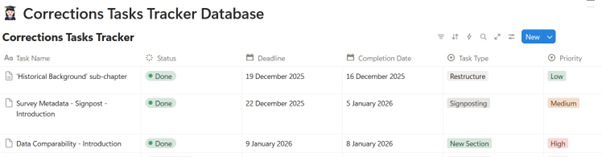
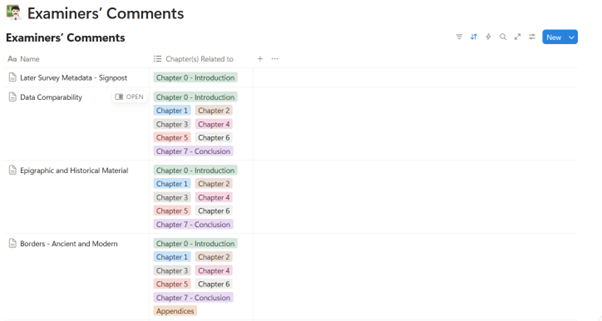
Now in March, reflecting on the completed and uncompleted tasks, I realise that some tasks require more time than others. As a part-time student, I am grateful for the support of my supervisors, examiners, family and friends as I navigate the corrections process and focus on each task on a weekly basis.
Discover more from UoB PGR Development blog
Subscribe to get the latest posts sent to your email.